It is now official, a second gifted-talented kid inhabits our house: Boy.
The school district tested him and qualified him for their advanced program. God have mercy on them all. He starts K next year.
20060525

What will it take?
Does one need any further or better or more clearly-defined reason for the US Department of Defense to halt the use of the Social Security number as an identifying number, than this one?
Emphasis mine.
Will we soon have some veteran, with the plastic tubes shoved up his nose to deliver his life-preserving oxygen, bitching to Congress about how his identity has been stolen, how his mil pension is now redirected to a meth lab on the other side of the Mississippi? How about a Korean-era serviceman's widow dumped on the curb because she couldn't make her rent payments, because her identity was stolen?
Will it have to come to that?
This is an official announcement from The Enlisted Association of the National Guard, of the United States (EANGUS).
Theft of Veterans Affairs (VA) Personal Data
Monday, May 21, 2006. The Department of Veterans Affairs (VA) has recently learned that an employee, a data analyst, took home electronic data from VA, which he was not authorized to do. This behavior was in violation of our policies. This data contained identifying information including names, social security numbers, and dates of birth for up to 26.5 million veterans and some spouses, as well as some disability ratings.
Emphasis mine.
Will we soon have some veteran, with the plastic tubes shoved up his nose to deliver his life-preserving oxygen, bitching to Congress about how his identity has been stolen, how his mil pension is now redirected to a meth lab on the other side of the Mississippi? How about a Korean-era serviceman's widow dumped on the curb because she couldn't make her rent payments, because her identity was stolen?
Will it have to come to that?
20060418
20060403
Fa bene
One of the Christmas gifts from years past I finally got around to trying: pasta attachments that mate to the massive frigging power-take-off on the premium stand mixer I got for my Sainted Wife whom I do not deserve.
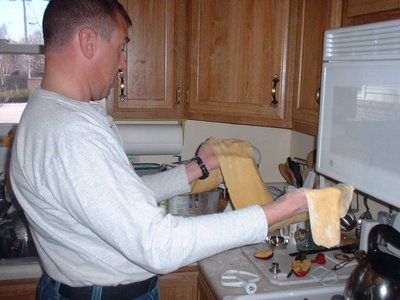
That was fun. Amazing how two cups of flour turns into a patch of noodle dough 10 centimeters wide by 10 meters long (though only microns thick).
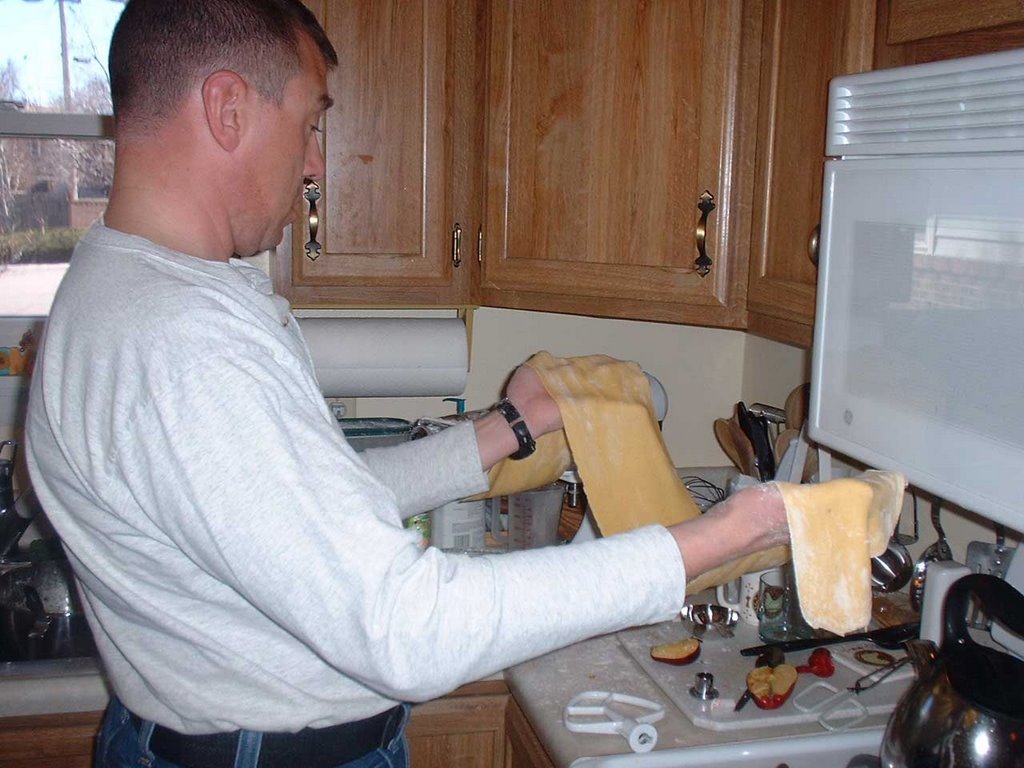
That was fun. Amazing how two cups of flour turns into a patch of noodle dough 10 centimeters wide by 10 meters long (though only microns thick).
20060402
Bike'n'shoot
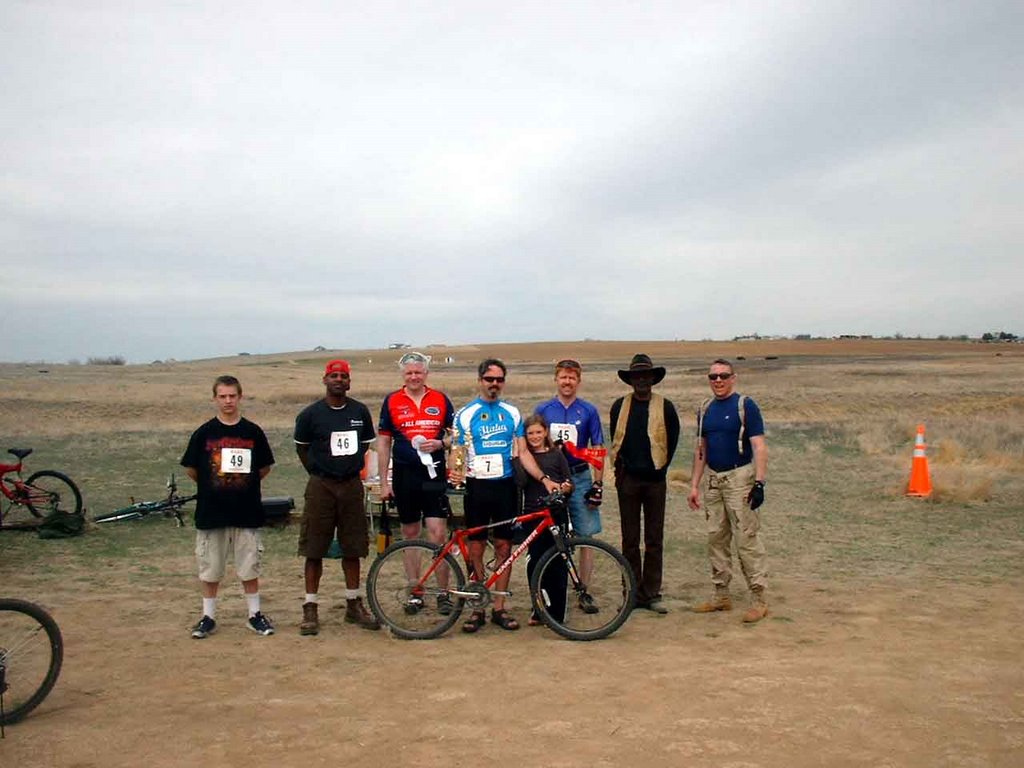
TCM and I met at the Bike'n'shoot. TCM, avid cyclist and dedicated shooter, placed.
Fûz finished without dying. He's the guy sucking wind on your right. TCM remains incognito.
20060315
Gas piston upper for AR15
File this under Noodling.
One repeated criticism of the AR15 design is its direct gas impingement action. Propellant gas is tapped from the barrel and led through a tube backwards into the receiver of the piece, and into the bolt carrier itself. The gas pressure works against a piston which is a rearward-facing surface of the bolt. The pressure builds between that face of the bolt and the internal surfaces of the bolt carrier ('directly impinging' upon the bolt), forcing them apart. A cam translates that force into rotation of the bolt, so its lugs disengage with their mating surfaces, the bolt unlocks, and the bolt carrier can retract, carrying the bolt with it.
The propellant gas passing through the bolt carrier leaves a mess behind, as a carbon buildup that has to be cleaned out, or it will build up to the point that the piece malfunctions.
The upside? Fewer parts and less weight compared to a firearm that contains this gas in a cylinder up front of the receiver, and uses the pressure to move an operating rod. In an indirect-impingement firearm, the operating rod moves the bolt carrier without depositing burnt-propellant crud in the receiver.
So the noodling goal is to improvise an operating rod that weighs the least possible and fits within the AR15 footprint--or a footprint expanded to what the market will accept.
Picatinny-rail forearms are the rage. A free-floating tube takes the place of the original AR15-type forearm nowadays, and Weaver-type rails are fastened to or forged integrally with the tube at 12, 3, 6 and 9-o'clock positions. Plenty of room exists within to contain a few grams of extra hardware.
The extra hardware consists of a spigot and an operating rod, fitting into a replacement gas block. The photo shows the first two parts and omits the gas block.

The spigot is up front and the op rod is to the rear. The spigot's rear section has an outer diameter that just matches the inner diameter of the op rod's frontward cylinder; the spigot's rear is male to the op rod's forward female. Cannelures are turned into the spigot's rear section to reduce weight and give the crud someplace to collect until the rifleman has time to take it out and clean it.
What the photo does not show is the yoke ("gas block"), the part that is fastened to the carbine barrel and is bored to take the spigot. The forward, thicker section of the spigot has keyways milled into it so it quarter-turns into the yoke to fasten there.
The yoke has a port bored in it so a hole in the barrel lets propellant gas out, through the port, into a matching port in the spigot. The spigot then redirects the propellant gas rearward into the op rod.
As the gas passes through the port, into the spigot, it enters the op rod's cylinder, filling it and pushing it rearwards.
A spring surrounds the rear tail of the op rod, and that spring compresses as the op rod retreats. The op rod's tail has the same diameter, minus x, as the original gas tube of the AR15, so it easily passes into the upper receiver and enters the bolt carrier key. The op rod tail pushes against the bolt carrier key, so when the op rod retreats, it pushes the bolt carrier key as surely as gas pressure in the tube would.
When the op rod retreats far enough, the rearmost face of the spigot is exposed, and the gas that filled the op rod cylinder can escape. No gas is introduced into the upper receiver along this route. The bolt carrier, having more mass than the op rod, keeps going rearward. The op rod runs out of gas, so to speak, and its return spring pushes it home again, back over the rear tail of the spigot.
The spigot guides the op rod's cylinder back home; only a millimeter or two of the op rod's travel will not be guided by the spigot, so there will be no need of a tube or rail to guide the op rod.
When the shooting day is ended, the operator can turn the spigot a quarter-turn or so, pull the spigot forward out of the yoke, and clean it off. The op rod will also come forward, through the yoke, and out the front of the carbine so its cylinder can be cleaned out. The op rod's cylinder's outer diameter is less than the inner diameter of the yoke's spigot passage.
Reassembly is reverse of disassembly.
All of it should fit within the confines of the modern Picatinny-railed handguard. Some propellant junk will accumulate within that handguard but that won't interfere with operation of the carbine. A toothbrush will get it out. Some tuning of internal surfaces of the handguard may be necessary to guide the op rod on its travel, and to buffer the op rod's return spring.
The challenges? First, to make the parts very light. If the walls of the op rod's cylinder are thin enough, they'll heat up in protracted fire so propellant gunk will burn off rather than build up. Too thin, though, and the walls will rupture. The yoke and spigot have to be kept light too. All of it will have to be steel rather than aluminum alloy, to resist the burning propellant gases.
Another problem would be the bowing of the tail of the op rod under firing pressure. If it flexes or bows too much it will bind against the hole in the upper receiver instead of shoving the bolt carrier rearward. Maybe the tail could be peened with flats so it will bow at more nodes but with less amplitude. This will be less of a problem with shorter-barreled carbines, such as the M4, because the tail will be shorter than that of the A3 rifle, with same diameter, thus stiffer.
One repeated criticism of the AR15 design is its direct gas impingement action. Propellant gas is tapped from the barrel and led through a tube backwards into the receiver of the piece, and into the bolt carrier itself. The gas pressure works against a piston which is a rearward-facing surface of the bolt. The pressure builds between that face of the bolt and the internal surfaces of the bolt carrier ('directly impinging' upon the bolt), forcing them apart. A cam translates that force into rotation of the bolt, so its lugs disengage with their mating surfaces, the bolt unlocks, and the bolt carrier can retract, carrying the bolt with it.
The propellant gas passing through the bolt carrier leaves a mess behind, as a carbon buildup that has to be cleaned out, or it will build up to the point that the piece malfunctions.
The upside? Fewer parts and less weight compared to a firearm that contains this gas in a cylinder up front of the receiver, and uses the pressure to move an operating rod. In an indirect-impingement firearm, the operating rod moves the bolt carrier without depositing burnt-propellant crud in the receiver.
So the noodling goal is to improvise an operating rod that weighs the least possible and fits within the AR15 footprint--or a footprint expanded to what the market will accept.
Picatinny-rail forearms are the rage. A free-floating tube takes the place of the original AR15-type forearm nowadays, and Weaver-type rails are fastened to or forged integrally with the tube at 12, 3, 6 and 9-o'clock positions. Plenty of room exists within to contain a few grams of extra hardware.
The extra hardware consists of a spigot and an operating rod, fitting into a replacement gas block. The photo shows the first two parts and omits the gas block.
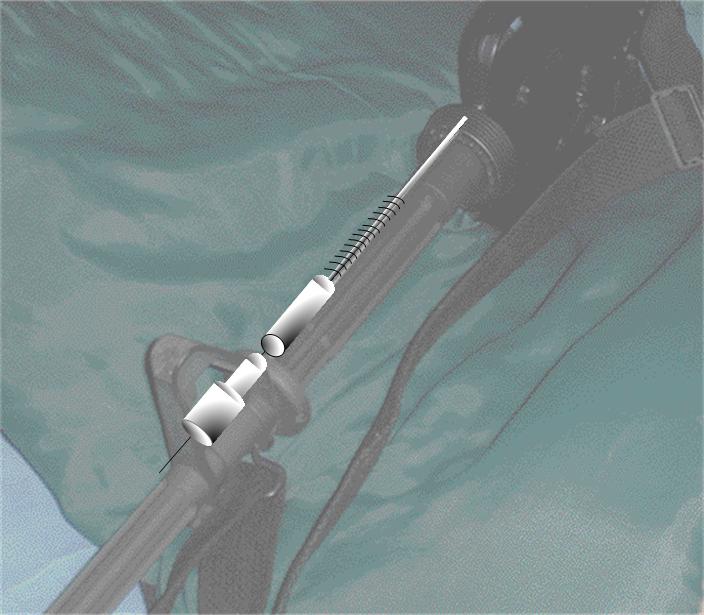
The spigot is up front and the op rod is to the rear. The spigot's rear section has an outer diameter that just matches the inner diameter of the op rod's frontward cylinder; the spigot's rear is male to the op rod's forward female. Cannelures are turned into the spigot's rear section to reduce weight and give the crud someplace to collect until the rifleman has time to take it out and clean it.
What the photo does not show is the yoke ("gas block"), the part that is fastened to the carbine barrel and is bored to take the spigot. The forward, thicker section of the spigot has keyways milled into it so it quarter-turns into the yoke to fasten there.
The yoke has a port bored in it so a hole in the barrel lets propellant gas out, through the port, into a matching port in the spigot. The spigot then redirects the propellant gas rearward into the op rod.
As the gas passes through the port, into the spigot, it enters the op rod's cylinder, filling it and pushing it rearwards.
A spring surrounds the rear tail of the op rod, and that spring compresses as the op rod retreats. The op rod's tail has the same diameter, minus x, as the original gas tube of the AR15, so it easily passes into the upper receiver and enters the bolt carrier key. The op rod tail pushes against the bolt carrier key, so when the op rod retreats, it pushes the bolt carrier key as surely as gas pressure in the tube would.
When the op rod retreats far enough, the rearmost face of the spigot is exposed, and the gas that filled the op rod cylinder can escape. No gas is introduced into the upper receiver along this route. The bolt carrier, having more mass than the op rod, keeps going rearward. The op rod runs out of gas, so to speak, and its return spring pushes it home again, back over the rear tail of the spigot.
The spigot guides the op rod's cylinder back home; only a millimeter or two of the op rod's travel will not be guided by the spigot, so there will be no need of a tube or rail to guide the op rod.
When the shooting day is ended, the operator can turn the spigot a quarter-turn or so, pull the spigot forward out of the yoke, and clean it off. The op rod will also come forward, through the yoke, and out the front of the carbine so its cylinder can be cleaned out. The op rod's cylinder's outer diameter is less than the inner diameter of the yoke's spigot passage.
Reassembly is reverse of disassembly.
All of it should fit within the confines of the modern Picatinny-railed handguard. Some propellant junk will accumulate within that handguard but that won't interfere with operation of the carbine. A toothbrush will get it out. Some tuning of internal surfaces of the handguard may be necessary to guide the op rod on its travel, and to buffer the op rod's return spring.
The challenges? First, to make the parts very light. If the walls of the op rod's cylinder are thin enough, they'll heat up in protracted fire so propellant gunk will burn off rather than build up. Too thin, though, and the walls will rupture. The yoke and spigot have to be kept light too. All of it will have to be steel rather than aluminum alloy, to resist the burning propellant gases.
Another problem would be the bowing of the tail of the op rod under firing pressure. If it flexes or bows too much it will bind against the hole in the upper receiver instead of shoving the bolt carrier rearward. Maybe the tail could be peened with flats so it will bow at more nodes but with less amplitude. This will be less of a problem with shorter-barreled carbines, such as the M4, because the tail will be shorter than that of the A3 rifle, with same diameter, thus stiffer.
20060306
My car is my property, continued and revised
Please let me clarify some points about this earlier post.
I do not support a law that explicitly establishes a right to have a firearm in one's car while on an employer's property.
I do support a law that establishes an automobile as a person's property, protected with the same Fourth Amendment rights as one's papers, effects, and home.
I'm still wrestling with the idea that one can enter a contract that requires one to surrender a civil right. I've been wrestling with that idea for decades and probably will continue to do so in my grave. It's for greater minds than mine. Maybe Jed is right, interfering here is an impairment of the right of contract.
Some of my concerns arise from how one can be held to "enter a contract" by buying a house or entering a business, or taking a job. To me, it's not a contract unless it is for a fixed beginning and end dates, among person or persons identifiable, with consequences for failure to meet the stipulations of the contract on all parties, and a means to terminate the contract. There is only one entity with whom I have actually entered an employment contract, and it did indeed demand the circumscription of some of my civil rights, but that's because it's the frigging US military. They are a different animal entirely from being a grocery bagger, newspaper carrier, or cable geek, and ought to be. None of those other entities ran a contract past me. In the case of cable geekery, they tried: headhunters told me those attempts weren't contracts and are unenforceable.
Taking a job with a papermill is not necessarily entering a contract. Agreeing to take that job does not equate to implicit consent for the papermill's ownership to search my car while it is parked on their property in the course of my working there. Union work may differ.
What would make a "gun-free workplace" more palatable would be law or jursiprudence like that proposed for a "gun-free supermarket". Business A is welcome to assert its right to property over the building and grounds of its business, such that employees or patrons are forbidden from being armed while on that property. Business A knowingly surrenders indemnity for violence that occurs there, and maybe their insurer will note that fact and charge premiums accordingly.
Business A must also bear some costs---not directly financial, as in fines, but operating costs, signage, storage---to make sure its employees and customers know their choice and can comply with it at the place where they cross that boundary between public property and Business A's private property.
Business B chooses not to establish such a policy, and Business B is protected by law from any suit holding it responsible for violence that occurs there, provided Business B is not the perpetrator. Please read the comments to the post I linked immediately above, they illuminate.
Absent this kind of law, we have recourse only to public pressure. PR has discouraged businesses who were weighing "gun-free" policies for their customers: Burt auto dealerships in the Denver area, for example, responded positively to a call-and-write'em campaign; I've heard that Applebee's did also.
But if workplace violence is as prevalent as some say (well, is it?), and workplace violence succeeds in spite of "gun-free" workplace policies (leave the "because of" argument for another day), then employees are at greater risk than patrons. What about them? Failing to protect employees' RKBA is, in my view, implicit acceptance of the principle that the presence of a gun causes crime regardless of the character of the people involved: 'It doesn't matter who you are, or who your co-workers are, doesn't matter how well I checked you out before I hired you. If the gun is there somebody might get hurt.'
Distinctions regarding what really constitutes private property take on new meaning here, and I stress them.
*******
Jed and I, and all five of my other regular readers, should be so lucky that someday the individual RKBA receives the respect and juridicial deference that are implied in this discussion. We are still trying to secure an uncertain and tragically disrespected RKBA in our own homes and on public streets; the right answers for RKBA within places of employment, worship, and commerce, at some presumed distance from the purely public sphere, depend on agreement that an individual RKBA exists. Such agreement cannot exist in a nation and at a time where mere possession of the instrument in private without State permission can be a crime, or in a city whose civic leaders or sworn peace officers can unilaterally call for the instruments' wholsale seizure.
Perhaps it is a sign of progress that our legislators and courts are now weighing the RKBA against other rights, without obvious intent to use that balancing act to short-sheet RKBA. Perhaps the RKBA can be defined, in part, from the outside in---where must it recede in importance versus other rights?
I do not support a law that explicitly establishes a right to have a firearm in one's car while on an employer's property.
I do support a law that establishes an automobile as a person's property, protected with the same Fourth Amendment rights as one's papers, effects, and home.
I'm still wrestling with the idea that one can enter a contract that requires one to surrender a civil right. I've been wrestling with that idea for decades and probably will continue to do so in my grave. It's for greater minds than mine. Maybe Jed is right, interfering here is an impairment of the right of contract.
Some of my concerns arise from how one can be held to "enter a contract" by buying a house or entering a business, or taking a job. To me, it's not a contract unless it is for a fixed beginning and end dates, among person or persons identifiable, with consequences for failure to meet the stipulations of the contract on all parties, and a means to terminate the contract. There is only one entity with whom I have actually entered an employment contract, and it did indeed demand the circumscription of some of my civil rights, but that's because it's the frigging US military. They are a different animal entirely from being a grocery bagger, newspaper carrier, or cable geek, and ought to be. None of those other entities ran a contract past me. In the case of cable geekery, they tried: headhunters told me those attempts weren't contracts and are unenforceable.
Taking a job with a papermill is not necessarily entering a contract. Agreeing to take that job does not equate to implicit consent for the papermill's ownership to search my car while it is parked on their property in the course of my working there. Union work may differ.
What would make a "gun-free workplace" more palatable would be law or jursiprudence like that proposed for a "gun-free supermarket". Business A is welcome to assert its right to property over the building and grounds of its business, such that employees or patrons are forbidden from being armed while on that property. Business A knowingly surrenders indemnity for violence that occurs there, and maybe their insurer will note that fact and charge premiums accordingly.
Business A must also bear some costs---not directly financial, as in fines, but operating costs, signage, storage---to make sure its employees and customers know their choice and can comply with it at the place where they cross that boundary between public property and Business A's private property.
Business B chooses not to establish such a policy, and Business B is protected by law from any suit holding it responsible for violence that occurs there, provided Business B is not the perpetrator. Please read the comments to the post I linked immediately above, they illuminate.
Absent this kind of law, we have recourse only to public pressure. PR has discouraged businesses who were weighing "gun-free" policies for their customers: Burt auto dealerships in the Denver area, for example, responded positively to a call-and-write'em campaign; I've heard that Applebee's did also.
But if workplace violence is as prevalent as some say (well, is it?), and workplace violence succeeds in spite of "gun-free" workplace policies (leave the "because of" argument for another day), then employees are at greater risk than patrons. What about them? Failing to protect employees' RKBA is, in my view, implicit acceptance of the principle that the presence of a gun causes crime regardless of the character of the people involved: 'It doesn't matter who you are, or who your co-workers are, doesn't matter how well I checked you out before I hired you. If the gun is there somebody might get hurt.'
Distinctions regarding what really constitutes private property take on new meaning here, and I stress them.
*******
Jed and I, and all five of my other regular readers, should be so lucky that someday the individual RKBA receives the respect and juridicial deference that are implied in this discussion. We are still trying to secure an uncertain and tragically disrespected RKBA in our own homes and on public streets; the right answers for RKBA within places of employment, worship, and commerce, at some presumed distance from the purely public sphere, depend on agreement that an individual RKBA exists. Such agreement cannot exist in a nation and at a time where mere possession of the instrument in private without State permission can be a crime, or in a city whose civic leaders or sworn peace officers can unilaterally call for the instruments' wholsale seizure.
Perhaps it is a sign of progress that our legislators and courts are now weighing the RKBA against other rights, without obvious intent to use that balancing act to short-sheet RKBA. Perhaps the RKBA can be defined, in part, from the outside in---where must it recede in importance versus other rights?
20060305
Piranhas in Cheyenne
HB78 failed last week, and HB46 didn't make it even that far. The local paper's editorial pages argued strongly against 78, though I doubt that's what did it in. NRA's emails suggested that it competed with other bills regarding what Wyoming would do with its revenue surplus, and lost; the website for the Wyoming legislature also listed at least two other bills in the House that aimed to liberalize concealed carry. HB78 just went the farthest of them.
As I have said in other venues, concealed carry is liberalizing and expanding rapidly, such that I predict in 10 years all but two States will offer shall-issue CCW permits at the most restrictive, and many will have permit-free carry like Vermont has always had and Alaska recently adopted. Those two hold-out States will be at risk of losing Federal monies because they do not allow uniform CCW for their own citizens nor reciprocity with other States' CCWs. What Wyoming failed to get in HB78 this year will be back, again and again, until it is law. Permit-regulated concealed carry leads the way and makes permit-free laws palatable, passable, and therefore possible.
And someone will always be unhappy with it, even with the very idea of it. Since Wyoming Tribune Eagle does not load much of its content online, I can point you to neither their editorials nor to the lettitors they spawned. As I receive WTE only on Sundays, I can't riffle through the back issues to recreate the dialog either. Their copyright feathers might also get ruffled if I OCR'd them for reproduction here.
But what little I see still shows stark and embarrassing illiteracy on the part of concealed-carry opponents.
In particular, one Roger MacDonald-Evoy seems to have jumped the shark, by misidentifying the Second Amendment as the States' Rights Amendment, and arguing that the Second Amendment is a State or collective right.
I didn't know that anyone had designated one of the articles of the Bill of Rights as a states' rights amendment per se---as a Federalist, I assert that a) States have no rights, merely powers, which were intended to be broad, and b) the Federal government's powers were enumerated---relying on just one article to set this principle forth seems redundant on the one hand, and pitiably inadequate on the other. But we Federalists, though outspoken, are scarce. Other Constitutional philosophies, and even unconstitutional ones, prevail.
Don't get me wrong, I like Mac-evoy, as he calls himself; I've worked a little with him, and he shares some of my tastes, such as Firesign Theatre and Emerson, Lake, and Palmer. He's a witty fellow, and I'm a little surprised and disappointed he didn't prepare himself better for one of the blogosphere's best-illuminated topics.
The letters to WTE's editor today lit him up, including one from HB78's original sponsor. Again, I apologize that I can't link to them, because WTE doesn't put their content on-line. Mabye Macevoy thought this would be a simple appeal to logic, no more effort or trouble than stepping gently across the swamp of irrational redneck gunlove. Instead, he has piranhas roiling the water up to his 'nads and no firm place to stand.
As I have said in other venues, concealed carry is liberalizing and expanding rapidly, such that I predict in 10 years all but two States will offer shall-issue CCW permits at the most restrictive, and many will have permit-free carry like Vermont has always had and Alaska recently adopted. Those two hold-out States will be at risk of losing Federal monies because they do not allow uniform CCW for their own citizens nor reciprocity with other States' CCWs. What Wyoming failed to get in HB78 this year will be back, again and again, until it is law. Permit-regulated concealed carry leads the way and makes permit-free laws palatable, passable, and therefore possible.
And someone will always be unhappy with it, even with the very idea of it. Since Wyoming Tribune Eagle does not load much of its content online, I can point you to neither their editorials nor to the lettitors they spawned. As I receive WTE only on Sundays, I can't riffle through the back issues to recreate the dialog either. Their copyright feathers might also get ruffled if I OCR'd them for reproduction here.
But what little I see still shows stark and embarrassing illiteracy on the part of concealed-carry opponents.
In particular, one Roger MacDonald-Evoy seems to have jumped the shark, by misidentifying the Second Amendment as the States' Rights Amendment, and arguing that the Second Amendment is a State or collective right.
I didn't know that anyone had designated one of the articles of the Bill of Rights as a states' rights amendment per se---as a Federalist, I assert that a) States have no rights, merely powers, which were intended to be broad, and b) the Federal government's powers were enumerated---relying on just one article to set this principle forth seems redundant on the one hand, and pitiably inadequate on the other. But we Federalists, though outspoken, are scarce. Other Constitutional philosophies, and even unconstitutional ones, prevail.
Don't get me wrong, I like Mac-evoy, as he calls himself; I've worked a little with him, and he shares some of my tastes, such as Firesign Theatre and Emerson, Lake, and Palmer. He's a witty fellow, and I'm a little surprised and disappointed he didn't prepare himself better for one of the blogosphere's best-illuminated topics.
The letters to WTE's editor today lit him up, including one from HB78's original sponsor. Again, I apologize that I can't link to them, because WTE doesn't put their content on-line. Mabye Macevoy thought this would be a simple appeal to logic, no more effort or trouble than stepping gently across the swamp of irrational redneck gunlove. Instead, he has piranhas roiling the water up to his 'nads and no firm place to stand.
20060227
The employer's parking lot is his property but my car is my property
I disagree with Jed:
I'm not arguing for gun rights in this instance, but indeed property rights. My automobile is my property. The State has an interest in knowing what's in my car only so long as it is moving on a public road. They can require that my car bear identifying marks for several reasons, including the possible recovery of my property if it is stolen, as well as the enforcement of requirements to insure it for operation on public roads. The State can search it under (too) many circumstances, usually in connection with it moving on a public road.
I disagree that my property rights in my vehicle, and my rights in the other property my vehicle may contain, are conditioned by where that vehicle may be, whether moving or parked.
If I keep a piece in my car, and the car and the piece are lawfully mine, it's nobody's business whether I have a piece in it.
Any law which deprives a business of the right to control access to their private property, and the terms thereof, is a blatant violation of property rights. We cannot, and should not, defend gun rights at the expense of something so fundamental.
I'm not arguing for gun rights in this instance, but indeed property rights. My automobile is my property. The State has an interest in knowing what's in my car only so long as it is moving on a public road. They can require that my car bear identifying marks for several reasons, including the possible recovery of my property if it is stolen, as well as the enforcement of requirements to insure it for operation on public roads. The State can search it under (too) many circumstances, usually in connection with it moving on a public road.
I disagree that my property rights in my vehicle, and my rights in the other property my vehicle may contain, are conditioned by where that vehicle may be, whether moving or parked.
If I keep a piece in my car, and the car and the piece are lawfully mine, it's nobody's business whether I have a piece in it.
20060218
it's about LUUUUUURRRVE
Those rare times that I get to see HBO, it can still surprise and titillate.
And disturb. The teaser for this show suggests, at least to me, that it is aimed at religious fundies, and the kind of world the left thinks they'd like to build if they ever came to grasp the levers of political power.
Ha ha laugh oh that's funny he's got three conservatively-dressed Stepford milfs and he worries there's not enough of him to go around {it's not for every man!} ha ha isn't that just precious and the milfs fight over who's in charge and they have to work out a schedule where they pass him around like a bowl of Fritos y'know? salty greasy and corny
The live trailer included remarks from the producers, about how the show is not about polygamy, it's about LOVE. Ok sure. Sometimes a Frito is just a Frito.
And disturb. The teaser for this show suggests, at least to me, that it is aimed at religious fundies, and the kind of world the left thinks they'd like to build if they ever came to grasp the levers of political power.
Ha ha laugh oh that's funny he's got three conservatively-dressed Stepford milfs and he worries there's not enough of him to go around {it's not for every man!} ha ha isn't that just precious and the milfs fight over who's in charge and they have to work out a schedule where they pass him around like a bowl of Fritos y'know? salty greasy and corny
The live trailer included remarks from the producers, about how the show is not about polygamy, it's about LOVE. Ok sure. Sometimes a Frito is just a Frito.
How to get mugged in the sterile area of an airport
We are paying $8 plus for 24 hours of 802.11g internet access in the airport terminal. I may ultimately use about 10 of those hours, given last night's weather. But couldn't SBC sell their connectivity in realistic increments?
Who in an airport would order 24 hours of WiFi unless he's setting up a kiosk to sell fake Rolexes?
Who in an airport would order 24 hours of WiFi unless he's setting up a kiosk to sell fake Rolexes?
20060216
Could this law have helped Cory Maye?
From HB46, now passed out of Wyoming's House and headed to the Joint Committee on the Judiciary:
Of course it always hinges on what a DA asserts that a person "reasonably should have known," and on how well a defense counsel can counter to a jury what that DA asserts. But would Cory Maye be on death row if this law had been in effect at that place and time?
The only loophole that I see in this bill is the 'applicable law' standard for how a peace officer must identify himself. Should shouting "police", even repeatedly and through a bullhorn, suffice?
Regardless, reforms like this one still don't address the root of the problem---the overuse of dynamic entry.
A person who uses force as permitted in W.S.
6-2-602 is justified in using such force and is immune from
criminal prosecution and civil action for the use of such
force, unless the person against whom force was used is a
peace officer, who was acting in the performance of his
official duties and the officer identified himself in
accordance with any applicable law or the person using
force knew or reasonably should have known that the person
was a peace officer.
Of course it always hinges on what a DA asserts that a person "reasonably should have known," and on how well a defense counsel can counter to a jury what that DA asserts. But would Cory Maye be on death row if this law had been in effect at that place and time?
The only loophole that I see in this bill is the 'applicable law' standard for how a peace officer must identify himself. Should shouting "police", even repeatedly and through a bullhorn, suffice?
Regardless, reforms like this one still don't address the root of the problem---the overuse of dynamic entry.
20060212
and on your right, the Bridge to Nowhere
I drove past the Clinton Library this afternoon. Wow.
It does look just like a gigantic aluminum-sided trailer.
It does look just like a gigantic aluminum-sided trailer.
20060208
now that's country
I just found a Jim Reeves collection. His He'll Have To Go reminds me of the satire treatment of same by Homer and Jethro. I'd kill to have that.
None of this Toby Keith sh1t. Friggin tin-foil cowboy hats.
None of this Toby Keith sh1t. Friggin tin-foil cowboy hats.
Ooops
A chem detector rang the cherries with a false positive for nerve agent at the Russell Senate Office Building.
It could have been a cleaning lady spilling a large quantity of Simple Green. Some molecules that feature an ether linking to a glycol will trigger nerve agent detectors.
It could have been a cleaning lady spilling a large quantity of Simple Green. Some molecules that feature an ether linking to a glycol will trigger nerve agent detectors.
20060206
What I should have done in the first place
The scanner has been a Canon LiDE 20, bought at bargain-basement price at the BX on Golfball Prairie AFB a year ago.
The printer has been an Epson Stylus Color 740i, bought not long after we brought the G4 PowerMac home in '99.
A lot of water has passed under these bridges, in the form of emails to Canon's tech support to get their scanner to work on the Classic emulator on OS 10.2.8, then their upgraded drivers to run directly on OS X; emails to Epson to get their printer to play nice with a Linksys Ethernet print server; emails to Linksys to get their print server to play nice with the Epson.
It's been an expensive bargain and I'm not done paying for it. All I wanted was one multifunction printer/scanner/copier that runs on the home network with an IP address, and I can print to it from any of the menagerie of computers in the house.
The Linksys server has been yanked out and put in the box while I ponder tactics to return it for refund or credit. The Canon scanner is going to my workplace until we get our Sharp copier upgraded with a scanner and OCR. The Epson printer is perfectly mission capable.
But HP has found a place in our home. Their Photosmart 2575 connects directly to the home network. I installed its drivers on 3 machines---the PowerMac, a Win2k, and the Clandestine Blogging Platform's WinXP--and the only hitch I have is with printing from Mac Classic applications on the OS X emulator.
The support email is already sent to HP, with a $5 bet with any of my five devoted readers that they'll be unable to get that aspect of it to work. So I am holding on to the Epson printer, just to print from Mac Office 98.
The printer has been an Epson Stylus Color 740i, bought not long after we brought the G4 PowerMac home in '99.
A lot of water has passed under these bridges, in the form of emails to Canon's tech support to get their scanner to work on the Classic emulator on OS 10.2.8, then their upgraded drivers to run directly on OS X; emails to Epson to get their printer to play nice with a Linksys Ethernet print server; emails to Linksys to get their print server to play nice with the Epson.
It's been an expensive bargain and I'm not done paying for it. All I wanted was one multifunction printer/scanner/copier that runs on the home network with an IP address, and I can print to it from any of the menagerie of computers in the house.
The Linksys server has been yanked out and put in the box while I ponder tactics to return it for refund or credit. The Canon scanner is going to my workplace until we get our Sharp copier upgraded with a scanner and OCR. The Epson printer is perfectly mission capable.
But HP has found a place in our home. Their Photosmart 2575 connects directly to the home network. I installed its drivers on 3 machines---the PowerMac, a Win2k, and the Clandestine Blogging Platform's WinXP--and the only hitch I have is with printing from Mac Classic applications on the OS X emulator.
The support email is already sent to HP, with a $5 bet with any of my five devoted readers that they'll be unable to get that aspect of it to work. So I am holding on to the Epson printer, just to print from Mac Office 98.
20060205
Quote for the day
I have two replies when as a criminologist studying firearms issues I am asked would the world not benefit if there were no guns? First, 1200 years ago there were no guns. Yet, for excellent reasons, that period in Europe has been called the Dark Ages. Firearms are the only weaponry by which the weak can resist the strong. Their absence was characterized by oppression and massacre not peace.
Don Kates, quoted by David Hardy at Arms and the Law.
Kates's other reply is worth reading too.
20060125
Chun-bi!
We went for the Kia Sedona. USAA negotiated the price to about $800 over dealer invoice. The dealer had one equipped as we wanted, in the showroom. About 45 minutes after USAA told me about it, I called, brought over the paperwork, and offered the GMC for trade. They offered about what I expected. An hour or so after that, I drove the Kia home.
Mama-san very pleased. Very pleased.
Could I have done better? Probably, but I'm not terribly interested in knowing exactly how much better I could have done by dickering, haggling, and feigning attempts to leave the lot in disgust. During the testdrive a few weeks ago, the grizzled cowboy salesperson answered what questions he could, then just handed me the keys. "The gas gauge is near E," I said to him as I headed for Nationway. "You've got about 35 miles," he said. Them's balls. He let the car sell itself.
Well, sort of. He ticked off the warranty, the Michelins, the side curtains, the improvements over the 2005 model (thanks, Chaz, you were exactly right). But he was low-pressure like I've never seen. "We aren't going anywhere. Just give us a fair chance at your business."
Gawdddayahmm it's a 3.8L DOHC V6.
The hardest part about this car will be explaining to my UAW brother-in-law that I didn't buy (a) GM, (b) 'Murcan. That boy needs an exit strategy.
Mama-san very pleased. Very pleased.
Could I have done better? Probably, but I'm not terribly interested in knowing exactly how much better I could have done by dickering, haggling, and feigning attempts to leave the lot in disgust. During the testdrive a few weeks ago, the grizzled cowboy salesperson answered what questions he could, then just handed me the keys. "The gas gauge is near E," I said to him as I headed for Nationway. "You've got about 35 miles," he said. Them's balls. He let the car sell itself.
Well, sort of. He ticked off the warranty, the Michelins, the side curtains, the improvements over the 2005 model (thanks, Chaz, you were exactly right). But he was low-pressure like I've never seen. "We aren't going anywhere. Just give us a fair chance at your business."
Gawdddayahmm it's a 3.8L DOHC V6.
The hardest part about this car will be explaining to my UAW brother-in-law that I didn't buy (a) GM, (b) 'Murcan. That boy needs an exit strategy.
Damning with faint praise?
I was paid a compliment today, I think.
The lot of us were being bitched out, with some justification, and I sat and took it. I took responsibility for it. I was not leading, scarcely following.
Another of us later approached me and said she admired my ability to absorb the abuse.
Is that a compliment?
The lot of us were being bitched out, with some justification, and I sat and took it. I took responsibility for it. I was not leading, scarcely following.
Another of us later approached me and said she admired my ability to absorb the abuse.
Is that a compliment?
20060110
Making Swen's day
Swen weighs liberalization of Wyoming's self-defense laws.
FWIW, Swen, I didn't buy the leetle badge.
FWIW, Swen, I didn't buy the leetle badge.
Subscribe to:
Posts (Atom)

 Posts
Posts


